
North Carolina’s EV Boom
The Hidden Economics and Analytics Behind the Charging Revolution

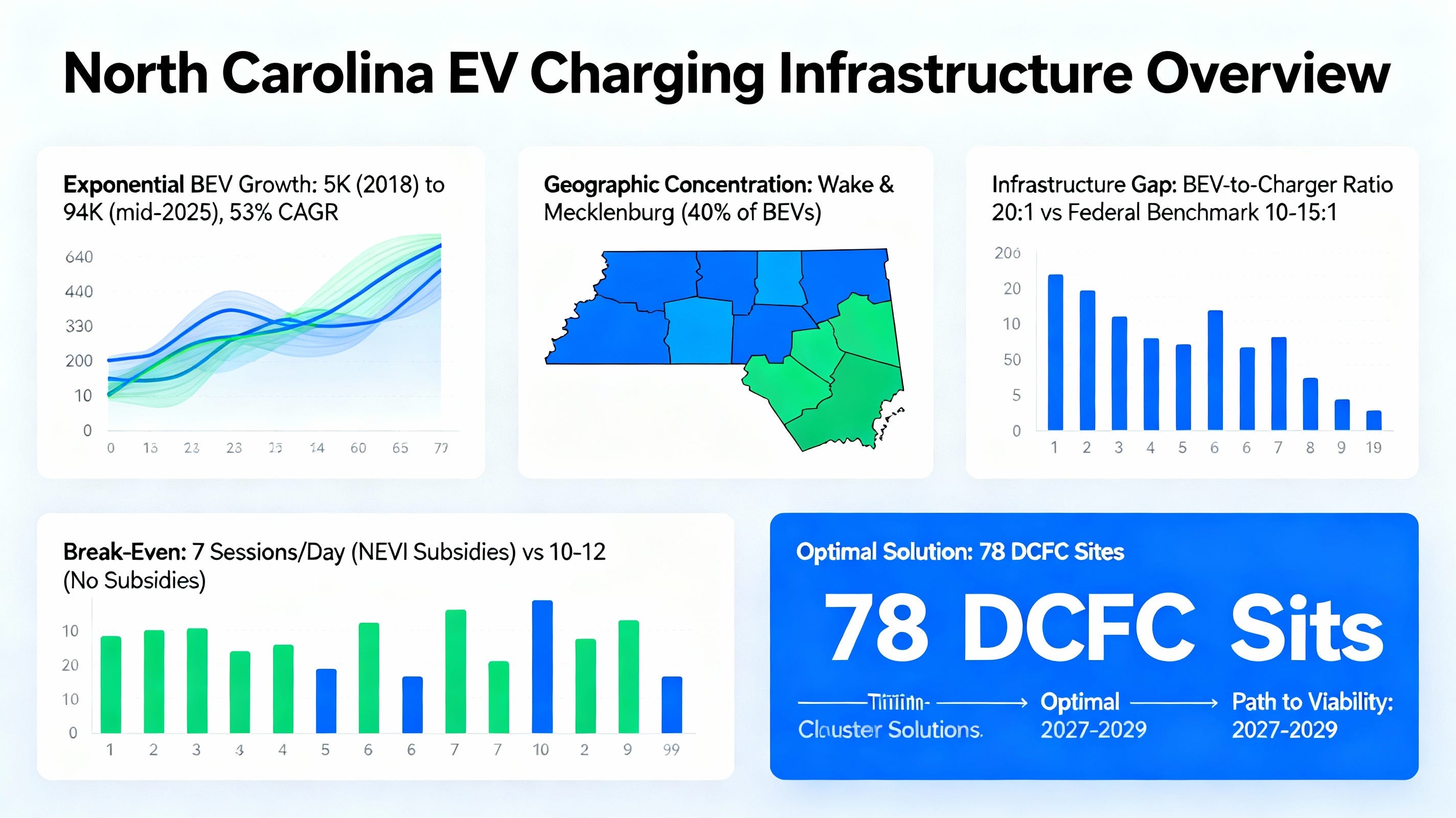
If you’ve driven around North Carolina lately, you’ve probably noticed a quiet shift happening right under your nose. Those smooth, almost-silent electric vehicles slipping across the highway? They aren’t rare anymore. They’re becoming part of our daily landscape.
And behind that visible change is a story most folks never see.
Battery Electric Vehicle (BEV) registrations in North Carolina have skyrocketed — from just 5,165 in 2018 to more than 94,000 by mid-2025. That’s not a trend… it’s a transformation.
But here’s the twist: every EV on the road depends on an entire ecosystem of chargers, grid capacity, planning models, costs, and policy frameworks. It’s not just “install more chargers.” It’s a complex, statewide puzzle.
Let’s break it down.
Takeaway 1: Most Public Chargers Aren’t Profitable (Yet)
This surprises almost everyone. Building chargers is expensive, usage is inconsistent, and the revenue model doesn’t match gas station economics. The business case gets stronger with scale — but we’re not there… yet.
Takeaway 2: Rural Counties Are Critical to the Puzzle
It’s not enough to serve Charlotte, Raleigh, and Durham. EV drivers need confidence when crossing rural stretches. For North Carolina to truly “go electric,” the map has to light up everywhere — not just the cities.
Takeaway 3: Fast Chargers Change Everything
Level 2 chargers are great for homes and workplaces, but DC Fast Chargers (DCFCs) are the backbone of accessible public charging. They require more planning, more power… and yes, more investment. But they unlock mobility.
Takeaway 4: The Grid Isn’t the Villain — But It Needs Support
Contrary to popular fear, the grid can handle the transition. The issue is local stress points and timing. Smart planning, energy storage, and rate design help smooth the load.
Takeaway 5: Data Drives Better Decisions — Not Guesswork
The real transformation happens behind the scenes:
forecasting adoption
modeling demand
planning optimal charger locations
testing scenarios
balancing cost vs. coverage
Data, not guesswork, is the compass.
Why This Matters for North Carolina’s Future
EVs aren’t just cars. They’re part of a broader economic strategy involving infrastructure, jobs, grid modernization, and equitable access. The decisions made today — where we place chargers, how we invest, what we prioritize — will shape mobility for years.
This transition isn’t accidental. It’s designed.
And it’s one heck of an analytics challenge.
Want More?
If you like clear, data-driven breakdowns of EV infrastructure, analytics, and business strategy, subscribe to WolfByte — where I’m diving deeper into:
EV planning
business analytics
infrastructure modeling
optimization strategies
and the stories behind the numbers
You’ll get practical insights without jargon — just the good stuff.
Acknowledgments
Huge thanks to my teammates — Raju Acharya, Braeden Baker, Ramon Rocha Silva — and to Dr. Nie for his teachings.